

Best Stationery for Executive Dysfunction: 7 Picks
Quick Summary
The best stationery for executive dysfunction is a simple tool that keeps the next step visible, such as sticky notes, a small notepad or a dot-grid journal left open on your desk. Start with one item that targets your most frustrating moment, whether that is starting a task, remembering a thought or planning a project. Keep the setup to three items or fewer and review it weekly.
- Physical tools stay in view, so they reduce the friction of starting a task.
- Ask what task keeps slipping before choosing a tool.
- Sticky notes cost $12.00 AUD and can be placed where reminders are needed.
- Build a setup with no more than three items: capture, planner and visible reminder.
- Review your setup weekly and remove anything you did not use that week.
Table of Contents
- Why Stationery Can Help With Executive Dysfunction
- How to Choose Stationery Without Adding Another Burden
- The Busy Head Planner: An Undated Daily Planner
- Visual Planning Tools That Keep Tasks in Sight
- Task Initiation Tools: Notepads, Sticky Notes and Pens
- Project Planning Workbooks and Journals for Complex Work
- Choosing Your First Tool and Building a Simple Setup
- Frequently Asked Questions
Why Stationery Can Help With Executive Dysfunction
Executive dysfunction makes starting and finishing tasks hard, even when you know exactly what needs doing. The right stationery can act as an external prompt, putting the next step in front of you so you do not have to hold it all in your head. For many neurodivergent adults with ADHD or autism, a visible, tactile tool does more than a planner app buried on a phone.
Physical tools work because they stay in view. A notepad on the desk, a sticky note on the laptop screen, or a journal left open to today's page keeps the task present without requiring a separate decision to open an app. This is often described as reducing friction: fewer steps between intention and action.
Sensory comfort matters too. Thick card, smooth ink and pleasing colours make writing feel less like a chore.
The limits are worth stating clearly. Stationery does not fix executive dysfunction on its own, and no single tool will suit every brain. The aim is to lower the barrier to starting, not to add another system to maintain. If the planning side of things feels overwhelming, working through it with a Coaching practitioner can help you identify which challenges matter most before you buy anything.
How to Choose Stationery Without Adding Another Burden
The biggest risk with any new system is that it becomes one more thing to abandon. Choose the simplest option that solves one specific problem, then stop there. A useful test is to ask whether the tool reduces the number of decisions you make in a day or adds to them. If it adds decisions, it is probably the wrong tool for now.
Ask four questions before you buy:
- What task keeps slipping? Pick a tool that targets that exact moment, such as capturing a thought, starting a task, or remembering a deadline. Match the tool to the executive function that is failing, not to the aesthetic of the system.
- Where will it live? A tool you can see and reach in under five seconds gets used. One stored in a drawer does not. A notepad left open on the desk is easier to reach than a journal kept on a shelf.
- How much upkeep does it need? A notepad needs nothing. A detailed workbook needs regular attention. Match the effort to what you can sustain on a low-energy day, not on your best day.
- What does it cost to try? A $12.00 AUD sticky notes set is a low-risk experiment. A $35.00 AUD hardcover journal is a bigger commitment. Start at the lower price point unless you already know the format works for you.
A transparent way to compare options is on five criteria: layout (does the page structure match how you think?), sensory features (paper texture, ink flow, cover feel), portability (will you carry it?), flexibility (can you use it on a bad day without guilt?), and upkeep (how often does it need attention?).
Paper versus digital is worth deciding deliberately rather than by habit. Paper suits capture, brainstorming, and anything you need to see at a glance without unlocking a device. Digital suits search, reminders, and anything you need to access in multiple places. A common pattern is a hybrid: paper for thinking and capture, digital for deadlines and appointments.
Start with one or two items rather than a full set. If a tool starts to feel like homework, that is a signal to simplify, not to try harder.
The Busy Head Planner: An Undated Daily Planner
The Busy Head Planner is an undated daily planner made for ADHD brains and neurodivergent creatives. It offers flexible daily structure rather than rigid hourly schedules, with gentle prompts to capture priorities and track energy.
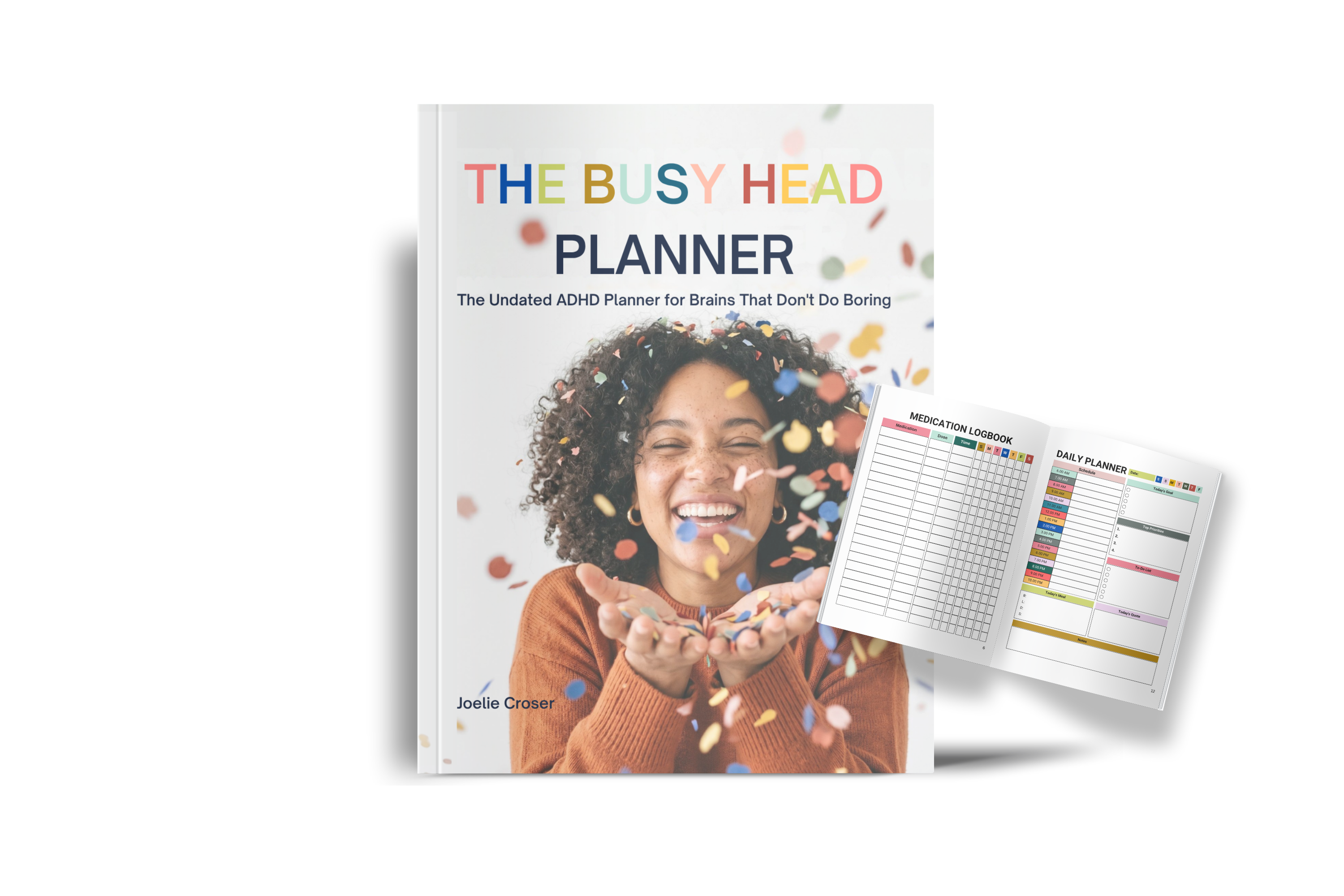
Because it is undated, you can start on any day and pick it back up whenever life gets busy. There is no penalty for missed days, which suits anyone who has abandoned dated planners after a bad week.
Pros
- No pressure to start on January 1 or keep unbroken streaks
- Low-pressure prompts instead of crowded white space
- Designed around flexible structure rather than strict schedules
Cons
- Less suited to people who want detailed time-blocking
- Daily pages only, so long-range planning needs another tool
- Costs more than a basic notebook
At $29.95 AUD, this is best for someone who has tried other planners and given up on them. If you want precise hourly scheduling, look elsewhere.
Best for: neurodivergent adults who want a forgiving daily planner. Skip if: you need hour-by-hour scheduling or a year-at-a-glance calendar.
Visual Planning Tools That Keep Tasks in Sight
Keeping tasks visible is one of the most effective low-effort strategies. Out of sight often means out of mind, so a planner or journal that sits open on your desk does more work than one stored on a shelf.
The Neuroblossom Project dot-grid journals suit people who like to sketch, list and map ideas. Each title, including Soft Landing, The Scatter Season, My Own Time and Root System, focuses on a different theme, so you can choose the one that matches your current season. At $16.00 AUD each, they are an affordable way to try a journal without committing to a large notebook.
Pros
- Dot grid supports sketching, lists and mind maps
- Four themed titles to match different phases
- Simple, low-pressure design
Cons
- Themed prompts may not suit everyone
- Dot grid can feel busy if you prefer plain lines
Best for: visual thinkers who want a journal that stays on the desk. Skip if: you need ruled pages for formal note-taking.
Task Initiation Tools: Notepads, Sticky Notes and Pens
Task initiation is often the hardest step. Small, quick tools lower the cost of starting, because capturing one thought takes seconds rather than a full planning session.
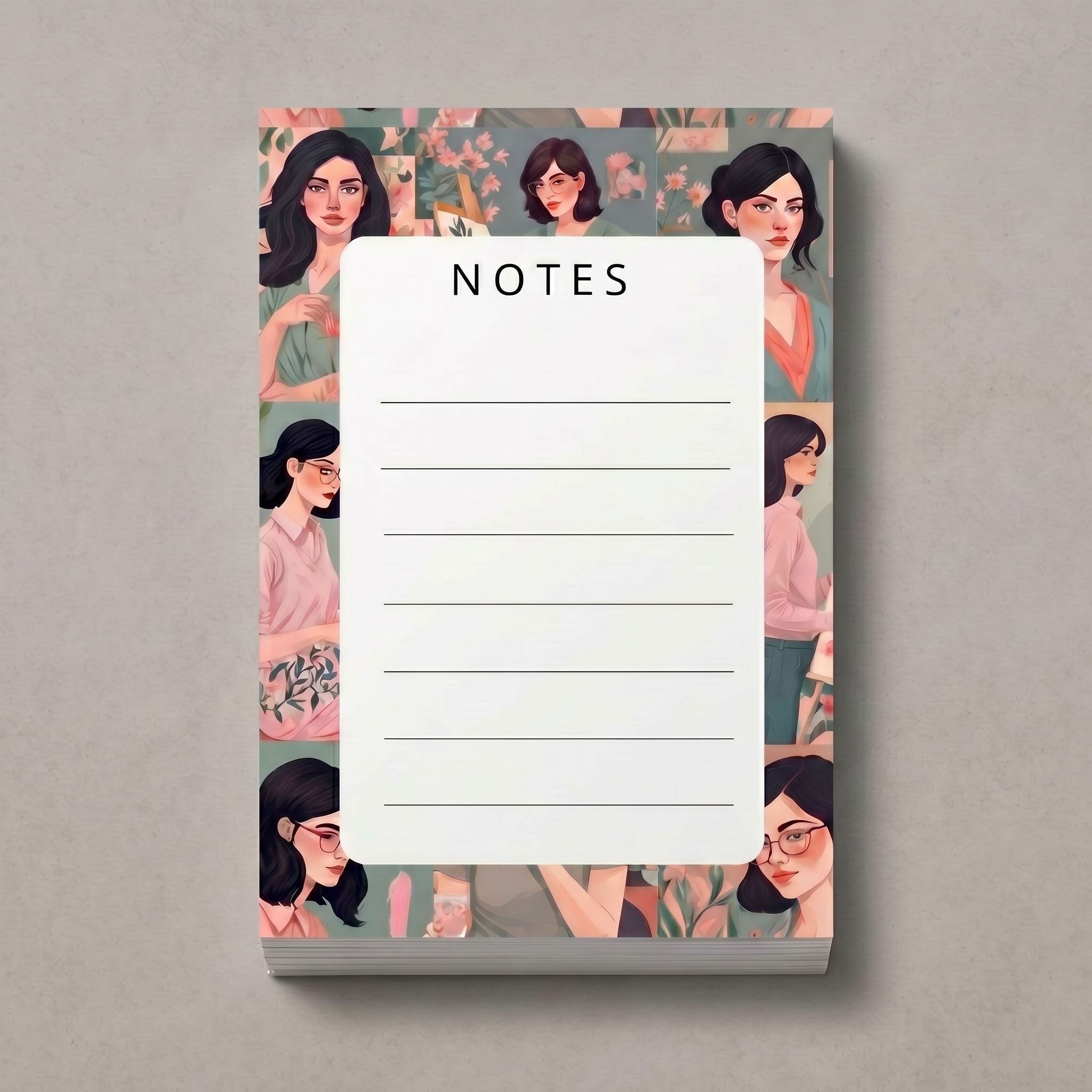
The Illustrated Neuroblossom Notepad is a 5x7 inch pad with 50 ruled pages of 200gsm card stock. It comes in two styles, Pink Hair, Botanical Tones and Dark Hair, Muted Florals, and at $18.00 AUD it suits to-do lists or getting thoughts out of your head before they disappear.
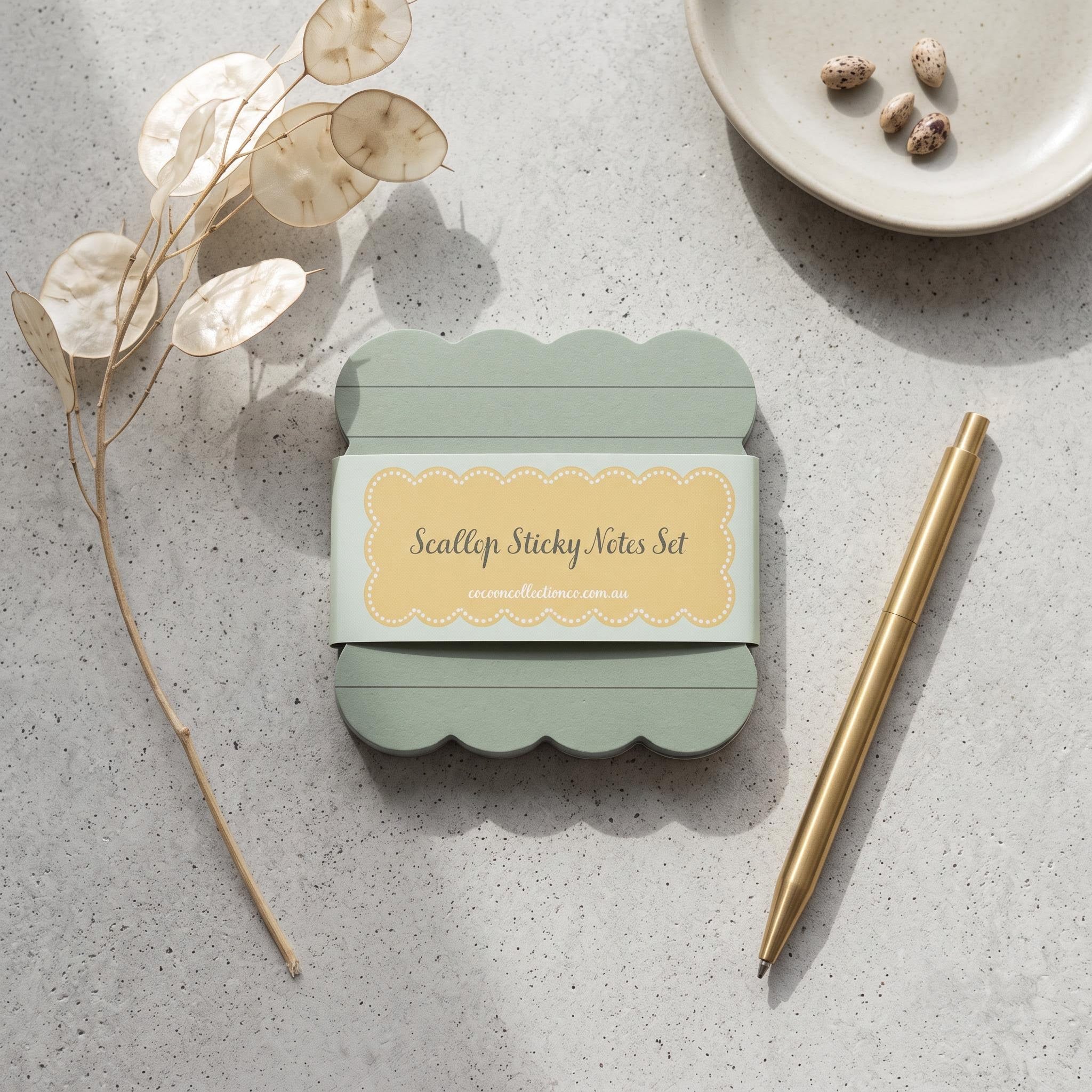
The Scallop Sticky Notes Set, Earthy Tones, is a set of three pads in muted sage and natural shades for $12.00 AUD. Stick one on your laptop, one in a book and one on the fridge. Keeping several pads in different places helps you catch a reminder when it matters.
The Hello, Wild Mind Gel Pen, at $12.95 AUD, has smooth black ink, a mint green barrel and a soft velveteen sleeve. A comfortable pen you enjoy using makes starting a list feel less effortful.
Pros
- Each item is inexpensive and quick to use
- Sticky notes place reminders exactly where they are needed
- Pleasant materials encourage regular use
Cons
- Loose notes are easy to lose if you have no home for them
- Sticky notes work best for short reminders, not long plans
Best for: a quick capture habit that costs little to try. Skip if: you need a single place to store all your tasks.
Project Planning Workbooks and Journals for Complex Work
Larger projects need more space to break down. A workbook or hardcover journal gives you room to map steps, track progress and sketch ideas over several weeks.
The Antihustle Strawberry Hardcover Journal is a sturdy journal with 100 dot-grid pages and a matte hardcover. At $35.00 AUD it is the most substantial item here, suited to bullet journalling, brain dumps and project sketches. Its dots offer structure when you want it and stay out of the way when you do not.
Pros
- Hardcover holds up to daily carrying
- Dot grid suits both lists and sketches
- Generous page count for long projects
Cons
- The highest price on this list
- Hardcover is less portable than a notepad
Best for: multi-week projects that need a place to think on paper. Skip if: you want something light to carry or a low-cost starting point.
Choosing Your First Tool and Building a Simple Setup
Start with one tool that matches your most frustrating moment. The table below maps common executive dysfunction challenges to the stationery that addresses them, so you can pick by problem rather than by product category.
| Challenge | What it looks like | Tool that helps | Why it works |
|---|---|---|---|
| Task initiation | You know what to do but cannot start | Sticky notes, a small notepad | Lowers the cost of the first step to seconds |
| Working memory | Thoughts vanish before you write them down | Notepad kept in view, sticky notes in several rooms | Captures the thought where it happens |
| Planning | Big projects feel impossible to break down | Dot-grid journal or workbook | Gives room to map steps over weeks |
| Time blindness | You lose track of how long things take | A visible timer or clock alongside your planner | Makes time passing concrete |
| Prioritisation | Everything feels equally urgent | Undated daily planner with a short priority list | Forces a small, finite set of priorities |
Build a simple setup with no more than three items: one capture tool, one main planner or journal, and one visible reminder. Keep the capture tool where the thoughts happen, keep the planner where you work, and keep the reminder where you will see it without looking for it.
Review the setup weekly and remove anything you did not use that week. A two-minute review is enough: note what you reached for, note what you ignored, and move or remove one item. The best system is the one you keep using, not the most complete one.
If daily structure is the problem, the Busy Head Planner at $29.95 AUD is a reasonable first step because its undated format removes the pressure of missed days. If you find that choosing tools is itself the sticking point, a Coaching session can help you work out a setup that fits how your brain actually operates.
Add one tool, use it for a fortnight, then decide whether a second is needed.
Cocoon Collection Co makes hand-crafted stationery and journals designed for neurodivergent thinkers. Browse the full range to find a starting point that suits your brain.
Frequently Asked Questions
What stationery helps with executive dysfunction?
Tools that reduce friction tend to work best: an undated daily planner so missed days don't cause guilt, sticky notes placed where you will see them, and a notepad for quick brain dumps. The most useful stationery makes the next step visible and easy to start. Items such as The Busy Head Planner ($29.95 AUD) and the Scallop Sticky Notes Set ($12.00 AUD) are designed around that idea of keeping priorities in sight without demanding a rigid routine.
What is the best planner for ADHD and executive dysfunction?
A planner that is undated and flexible tends to suit adults with ADHD better than a rigid hourly layout, because it lets you start again on any day without catching up. The Busy Head Planner is an undated daily planner at $29.95 AUD, with short prompts to capture priorities and track energy. Whether it suits you depends on whether you prefer structure on the page or open space to fill in your own way.
How do I choose a planner if I struggle to use planners consistently?
Start with the smallest tool that solves one problem. A single notepad or a set of sticky notes asks very little of you and is easy to abandon without guilt. Choose a planner only after you know which part of your day slips. Keep the first choice inexpensive, and avoid buying a complicated system all at once, since setting it up can become another task you put off.
Are paper planners or digital planners better for executive dysfunction?
Paper works well for many people because it stays on the desk and asks for no screen time, while digital tools offer reminders and easy rescheduling. Hybrid setups often suit best: a paper notepad for quick capture and a planner for the day's priorities. Test one approach for a couple of weeks before committing, and choose the format you are most likely to open each morning.
Price of Stationery Items in AUD
